
From Connectivity to Trust
the next step for the Internet
From connectivity to trust: the next step for the Internet
Over the past 25 years, the Internet has changed beyond recognition. But according to NL-ix founder and CEO Jan Hoogenboom, one of the biggest changes is not how much traffic we exchange or how much bandwidth we can provide. It is how deeply businesses have come to rely on the Internet for their applications and critical business processes. And that is shifting the conversation from connectivity to trust.
In 2001, the Internet was a very different place. Wikipedia had just launched, we searched with Yahoo, talked through MSN and dial-up Internet was still a reality. The Internet was mainly a way for people to communicate with each other, and connectivity itself was still the challenge. We talked about ports, bandwidth, IP addresses, AS numbers, BGP and routing.
Those technologies were important, but for NL-ix they were never the actual objective. The objective was autonomy: giving customers independence and control over how they reached the outside world. The Internet Exchange was a means to achieve that. That same thinking was behind the decision to build NL-ix as a distributed Internet Exchange. Instead of requiring customers to bring their traffic to one city, NL-ix expanded across Western Europe and brought connectivity closer to the customer.
At the time, building a distributed IX was considered an unusual idea. Today, its relevance has become much clearer, because the Internet itself has changed.
The Internet has become business infrastructure
Enterprises increasingly run their business processes outside their own domain. Cloudification has moved applications into data centres and cloud environments across Europe. An average organisation can now use around 150 external applications, with tens of them potentially mission-critical. The Internet has become the linking pin between all of it.
That fundamentally changes what businesses need from the Internet. Infrastructure should work like water from the tap: you use it every day without having to think about everything happening behind it. The same increasingly applies to connectivity. Enterprises rely on it completely. They expect it to be there and they expect it to work.
But when applications and critical business processes move outside your own environment, another question becomes much more important: what happens to your traffic once it is out there on the Internet?
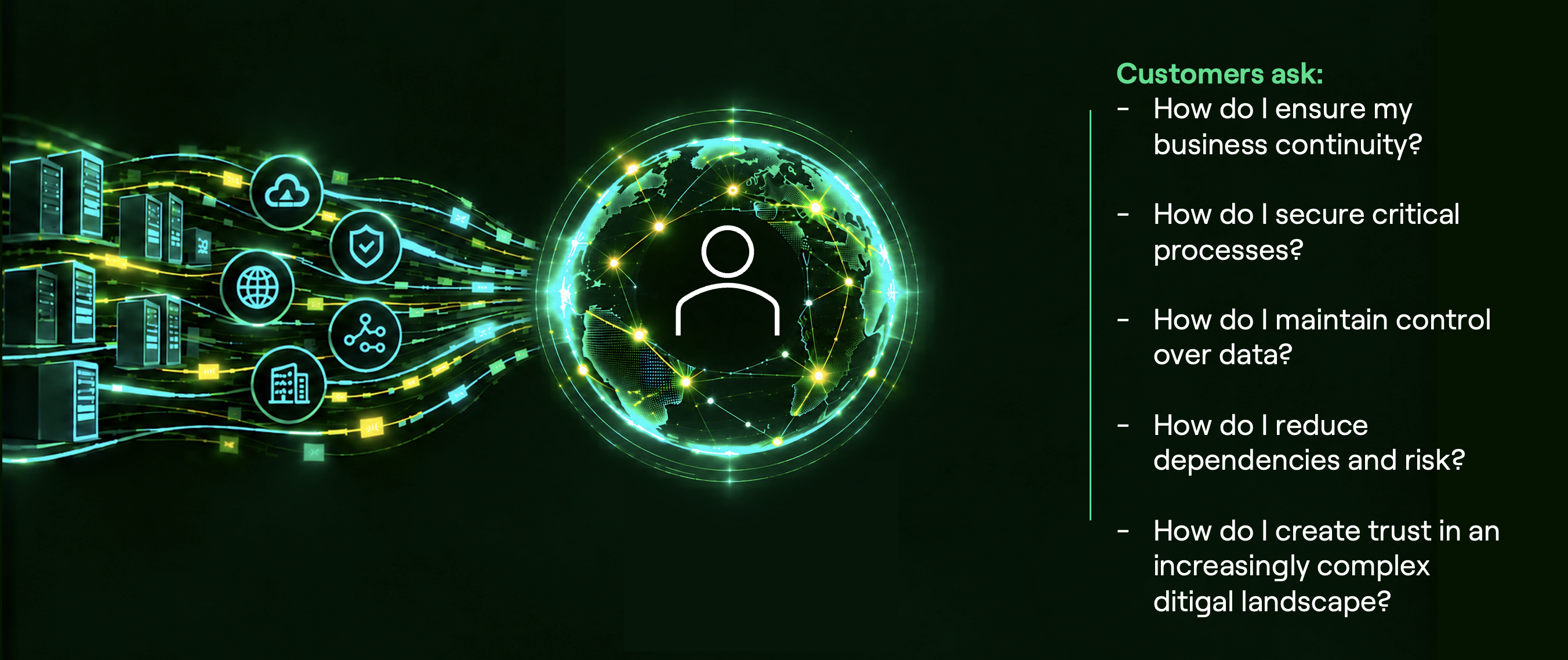
Where does it go, which networks does it cross, does it leave the EU and who can potentially see it? And, ultimately, how much control do you still have over it? These are no longer questions about bandwidth. They are questions about business continuity, security, sovereignty, autonomy and trust.
The applications moved outside
This also changes the relevance of a distributed Internet Exchange. Applications that used to run within the enterprise environment can now be distributed across data centres and cloud platforms throughout Europe, and some of those applications become business-critical very quickly.
The distributed infrastructure NL-ix has built over the years now enables us to reach around 95% of enterprise traffic on-net. That means a large part of the traffic an enterprise depends on can remain within the NL-ix network, giving organisations more control over how that traffic is handled and routed.
That is becoming increasingly important because the more of your business you put out there on the Internet, the more important it becomes to understand and control how you reach it.
Cloudification has already accelerated that development, and AI, digital sovereignty, security and geopolitics are adding new questions. Where does my traffic go? Who can potentially see it? Can I control the path it takes? Can I keep specific traffic within an environment I trust?
For enterprises, this changes the conversation. It is no longer just about having connectivity. It is about being able to rely on the Internet for increasingly critical parts of the business while maintaining control over the traffic that connects them.
That is the shift from connectivity to trust.
The next step is application awareness
So what comes next? According to Jan, we need to start the conversation somewhere else: with the application.
Instead of first asking customers about ports and bandwidth, we need to understand which applications they use and which of those applications really matter. Which are business-critical? Where are the security risks? Where are the sovereignty risks? And what level of control does the organisation need over the traffic to those applications?
That means our people need to become more application-aware, but more importantly, our infrastructure needs to become application-aware too. Not every application has the same requirements and, therefore, not every traffic flow needs to be treated in exactly the same way. Some traffic may require a different level of control, security or sovereignty than other traffic.
Understanding that difference is an important next step. If we understand the application and its importance to the business, we can also better understand what that application requires from the infrastructure underneath it.
Building towards trust
This shift has already influenced how NL-ix has developed its infrastructure and services. As the Internet became mission-critical for enterprises, enterprise-grade services and SLAs became necessary. The B-fabric was built to further increase availability, DDoS Protection brought protection into the network, and Sovereign Internet introduced the ability to separate Internet traffic depending on the level of sovereignty required.
These are different steps, but they all respond to the same development. As enterprises become more dependent on the Internet, simply providing connectivity is no longer enough. They need to be able to rely on it and retain control over how they use it.
For NL-ix, that means continuing the same principle we started with 25 years ago, but applying it to a very different Internet.
From Internet Exchange to European Business Exchange
The role of an Internet Exchange has to move with that development.
Exchanging traffic remains fundamental, but the conversation with enterprises can no longer start and end with ports and bandwidth. If their applications and critical business processes increasingly run over the Internet, we need to understand what they are using that connectivity for and what level of control they need.
That is the thinking behind NL-ix as the European Business Exchange: a distributed European interconnection platform that helps organisations maintain control over the Internet traffic their business depends on.
It means looking at the application first, understanding what it requires and then determining what the infrastructure underneath it needs to provide.
The next 25 years
Twenty-five years ago, NL-ix started by helping customers gain more control over their connectivity. That mission has not fundamentally changed. We still want to give customers control, help them remain autonomous and take away as much of the underlying complexity as possible.
What has changed is where the business now lives. Applications and critical business processes have increasingly moved outside the traditional enterprise environment and onto the Internet. And when more of your business moves onto the Internet, control over your traffic becomes more important, not less.
That is where Jan sees the next step for NL-ix and the wider Internet industry: becoming more application-aware and using that understanding to provide the trust enterprises increasingly need.
Because for the next 25 years, the challenge is not simply to connect more.
It is to give businesses the control they need to trust the Internet their business runs on.
The next step is application awareness
So what comes next? According to Jan, we need to start the conversation somewhere else: with the application.
Instead of first asking customers about ports and bandwidth, we need to understand which applications they use and which of those applications really matter. Which are business-critical? Where are the security risks? Where are the sovereignty risks? And what level of control does the organisation need over the traffic to those applications?
That means our people need to become more application-aware, but more importantly, our infrastructure needs to become application-aware too. Not every application has the same requirements and, therefore, not every traffic flow needs to be treated in exactly the same way. Some traffic may require a different level of control, security or sovereignty than other traffic.
Understanding that difference is an important next step. If we understand the application and its importance to the business, we can also better understand what that application requires from the infrastructure underneath it.
Building towards trust
This shift has already influenced how NL-ix has developed its infrastructure and services. As the Internet became mission-critical for enterprises, enterprise-grade services and SLAs became necessary. The B-fabric was built to further increase availability, DDoS Protection brought protection into the network, and Sovereign Internet introduced the ability to separate Internet traffic depending on the level of sovereignty required.

These are different steps, but they all respond to the same development. As enterprises become more dependent on the Internet, simply providing connectivity is no longer enough. They need to be able to rely on it and retain control over how they use it.
For NL-ix, that means continuing the same principle we started with 25 years ago, but applying it to a very different Internet.
From Internet Exchange to European Business Exchange
The role of an Internet Exchange has to move with that development.
Exchanging traffic remains fundamental, but the conversation with enterprises can no longer start and end with ports and bandwidth. If their applications and critical business processes increasingly run over the Internet, we need to understand what they are using that connectivity for and what level of control they need.
That is the thinking behind NL-ix as the European Business Exchange: a distributed European interconnection platform that helps organisations maintain control over the Internet traffic their business depends on.
It means looking at the application first, understanding what it requires and then determining what the infrastructure underneath it needs to provide.
The next 25 years
Twenty-five years ago, NL-ix started by helping customers gain more control over their connectivity. That mission has not fundamentally changed. We still want to give customers control, help them remain autonomous and take away as much of the underlying complexity as possible.
What has changed is where the business now lives. Applications and critical business processes have increasingly moved outside the traditional enterprise environment and onto the Internet. And when more of your business moves onto the Internet, control over your traffic becomes more important, not less.
That is where Jan sees the next step for NL-ix and the wider Internet industry: becoming more application-aware and using that understanding to provide the trust enterprises increasingly need.
Because for the next 25 years, the challenge is not simply to connect more.
It is to give businesses the control they need to trust the Internet their business runs on.